



Strategic Change Management: processes, roles and incentives before the narrative
24 June 2026
Innovation in HR processes: experiences and success stories | Report
10 July 2026
1 July 2026
Beyond compliance: Pay Transparency as a strategic lever HR | Report
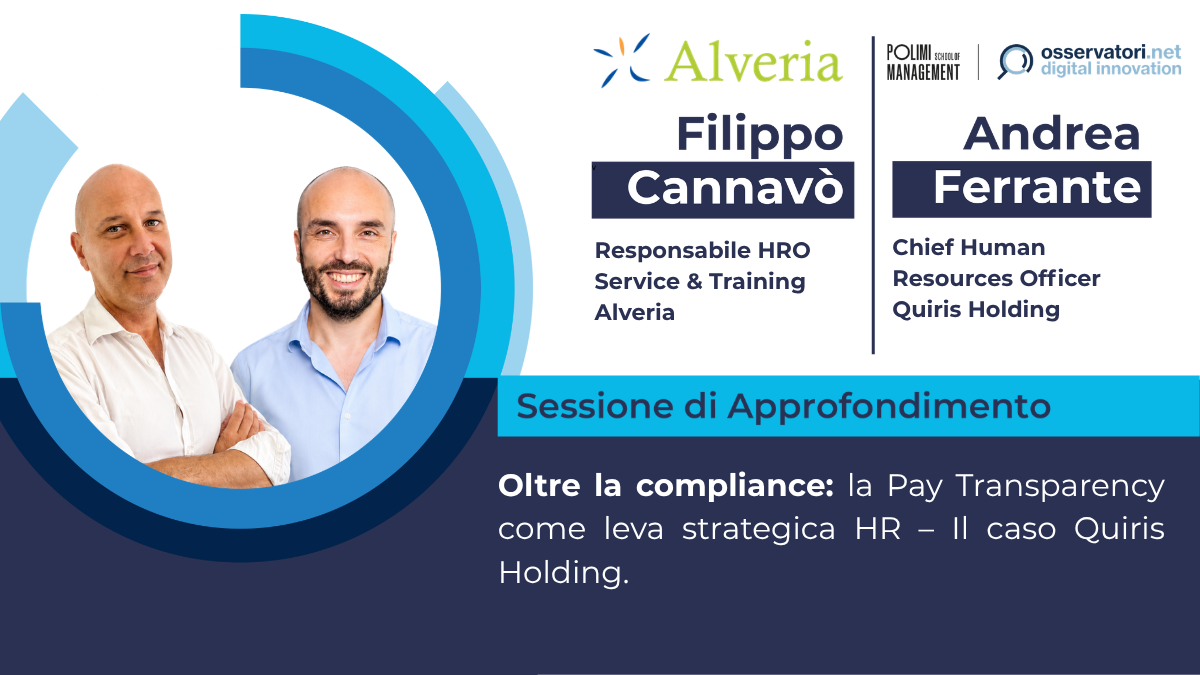
On 26 June An in-depth session was held on a topic that is becoming increasingly important for organisations: pay transparency. The key speakers at the meeting were Filippo Cannavò (Head of HRO Service & Training at Alveria) and Andrea Ferrante (CRO of Quiris Holding), who shared the company’s approach to transforming a regulatory requirement into a strategic lever for the evolution of the HR function.
From compliance to organisational opportunity
One of the key messages to emerge from the speech is clear: Pay transparency cannot be treated as a mere compliance requirement. Reducing it to mere “compliance” means exposing oneself to high risks, because organisational complexity does not lend itself to superficial interpretations. As Andrea Ferrante points out, transparency is “a ticking time bomb” if left unmanaged: it can generate tensions and misunderstandings, but it represents an extraordinary opportunity if managed as a genuine change management project. In this sense, Quiris Holding has chosen to use the European Directive as a driver of transformation, taking this opportunity to accelerate a transition that is already underway: the shift from a family-run business to a managerial organisation.
The “Beyond Pay Transparency” project”
This approach has been put into practice in the project “Beyond Pay Transparency”, which enabled Quiris Holding to secure a significant recognition to the HR Innovation Awards, in the category “A data-driven and proactive HR management approach”. The project was launched against a backdrop of strong business growth and aims to develop a more objective, transparent and data-driven people management model. It is therefore not simply a matter of analysing remuneration, but of fundamentally rethinking the entire organisational system.
The enabling role of technology
A key element of the process was the adoption of the platform HCMS of Alveria, which has made it possible to:
- to map organisational roles in a structured way
- to form homogeneous clusters of positions
- to analyse and monitor pay discrepancies
- distinguish between explained and unexplained gaps
This data-driven approach not only enables us to identify any discrepancies, but also to understand their causes. The ability to explain pay differentials is, in fact, a crucial step, particularly when these exceed certain thresholds or become the subject of regulatory scrutiny.
The starting point: positions, not levels
Another important insight concerns the starting point of the analysis: not the contractual level, but the organisational position. As Filippo Cannavò has pointed out, limiting oneself to the levels set out in the national collective labour agreements risks obscuring critical issues, such as cases where a position is classified below its actual value.
For this reason, it is essential to adopt a “double vision”:
- on the one hand, regulatory and contractual constraints
- on the other hand, an organisational assessment based on skills, responsibilities and working conditions
Internal equity, external benchmarks and company policies
The project also highlighted the need to distinguish between:
- internal equity, relating to the consistency between roles and pay
- external equity, based on a comparison with the market
Companies are required to draw up their own policy on the weighting of positions, by determining the relative weighting of factors such as skills, responsibilities and seniority. There are no strict regulatory constraints in this regard: it is a strategic and cultural choice.
Transparency and organisational culture
A central theme One issue that emerged during the meeting concerns the management of internal communication. Transparency, in fact, inevitably gives rise to questions and discussions amongst staff. If left unmanaged, this dynamic can lead to the creation of “information gaps” which are filled by personal perceptions and beliefs. As Ferrante points out, it is essential not to leave these gaps unfilled, but to manage them through tools, data and structured communication.
A HR transformation driver
The Quiris case demonstrates how the integration of data, technology and organisational culture can drive a new evolution of the HR function.
Pay transparency works as follows:
- a means of achieving greater fairness
- a catalyst for organisational change
- a tool to support managerial decision-making
- a key factor in attracting and retaining talent
Ultimately, moving “beyond compliance” represents a strategic choice: transforming a regulatory obligation into a tangible opportunity to build organisations that are more aware, better structured and more sustainable.
CONSULTANCY, TRAINING, HR DIGITALIZATION AND CORPORATE SOLUTIONS, DISCOVER THE ALVERIA METHOD. GET READY FOR CHANGE.
On 26 June An in-depth session was held on a topic that is becoming increasingly important for organisations: pay transparency. The key speakers at the meeting were Filippo Cannavò (Head of HRO Service & Training at Alveria) and Andrea Ferrante (CRO of Quiris Holding), who shared the company’s approach to transforming a regulatory requirement into a strategic lever for the evolution of the HR function.
From compliance to organisational opportunity
One of the key messages to emerge from the speech is clear: Pay transparency cannot be treated as a mere compliance requirement. Reducing it to mere “compliance” means exposing oneself to high risks, because organisational complexity does not lend itself to superficial interpretations. As Andrea Ferrante points out, transparency is “a ticking time bomb” if left unmanaged: it can generate tensions and misunderstandings, but it represents an extraordinary opportunity if managed as a genuine change management project. In this sense, Quiris Holding has chosen to use the European Directive as a driver of transformation, taking this opportunity to accelerate a transition that is already underway: the shift from a family-run business to a managerial organisation.
The “Beyond Pay Transparency” project”
This approach has been put into practice in the project “Beyond Pay Transparency”, which enabled Quiris Holding to secure a significant recognition to the HR Innovation Awards, in the category “A data-driven and proactive HR management approach”. The project was launched against a backdrop of strong business growth and aims to develop a more objective, transparent and data-driven people management model. It is therefore not simply a matter of analysing remuneration, but of fundamentally rethinking the entire organisational system.
The enabling role of technology
A key element of the process was the adoption of the platform HCMS of Alveria, which has made it possible to:
- to map organisational roles in a structured way
- to form homogeneous clusters of positions
- to analyse and monitor pay discrepancies
- distinguish between explained and unexplained gaps
This data-driven approach not only enables us to identify any discrepancies, but also to understand their causes. The ability to explain pay differentials is, in fact, a crucial step, particularly when these exceed certain thresholds or become the subject of regulatory scrutiny.
The starting point: positions, not levels
Another important insight concerns the starting point of the analysis: not the contractual level, but the organisational position. As Filippo Cannavò has pointed out, limiting oneself to the levels set out in the national collective labour agreements risks obscuring critical issues, such as cases where a position is classified below its actual value.
For this reason, it is essential to adopt a “double vision”:
- on the one hand, regulatory and contractual constraints
- on the other hand, an organisational assessment based on skills, responsibilities and working conditions
Internal equity, external benchmarks and company policies
The project also highlighted the need to distinguish between:
- internal equity, relating to the consistency between roles and pay
- external equity, based on a comparison with the market
Companies are required to draw up their own policy on the weighting of positions, by determining the relative weighting of factors such as skills, responsibilities and seniority. There are no strict regulatory constraints in this regard: it is a strategic and cultural choice.
Transparency and organisational culture
A central theme One issue that emerged during the meeting concerns the management of internal communication. Transparency, in fact, inevitably gives rise to questions and discussions amongst staff. If left unmanaged, this dynamic can lead to the creation of “information gaps” which are filled by personal perceptions and beliefs. As Ferrante points out, it is essential not to leave these gaps unfilled, but to manage them through tools, data and structured communication.
A HR transformation driver
The Quiris case demonstrates how the integration of data, technology and organisational culture can drive a new evolution of the HR function.
Pay transparency works as follows:
- a means of achieving greater fairness
- a catalyst for organisational change
- a tool to support managerial decision-making
- a key factor in attracting and retaining talent
Ultimately, moving “beyond compliance” represents a strategic choice: transforming a regulatory obligation into a tangible opportunity to build organisations that are more aware, better structured and more sustainable.