


Beyond compliance: Pay Transparency as a strategic lever HR | Report
1 July 2026
Performance-Related Pay and Total Reward: the gap between design and actual impact
10 July 2026
10 July 2026
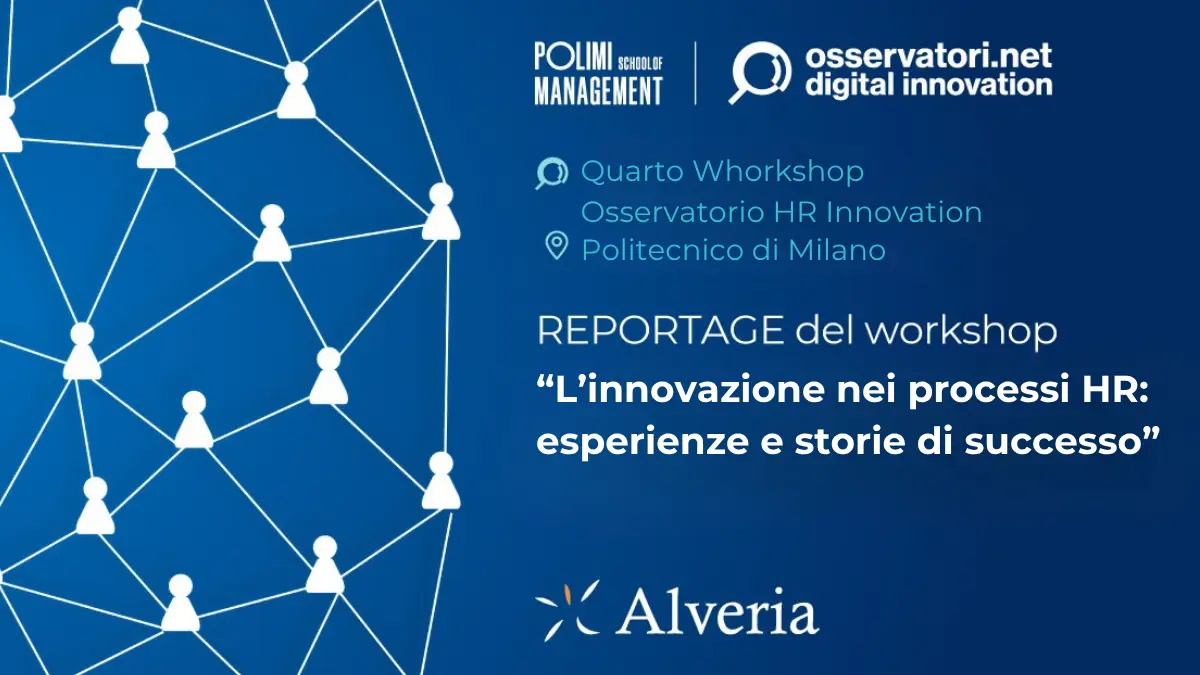
Innovation in HR processes: experiences and success stories | Report
On 23 June, the fourth and final workshop of the 2025–26 edition of the HR Innovation Observatory took place, entitled “Innovation in HR processes: experiences and success stories”, which involved 97 participants, including industry experts and HR representatives from the Observatory’s community. The meeting, organised in the “HR Innovation Talk” format, was dedicated to the sharing of practical examples of innovation in HR processes. Drawing on research data, company case studies and group discussions, the workshop explored three key areas for the evolution of the Direction HR: digital, welfare and training.
TOPIC: “HR and Digital: Innovation Aimed at Improving Processes”
The Observatory Research
The first session of the workshop was devoted to the topic “HR and digital”, with the aim of understanding how HR departments are investing in digital technologies and Artificial Intelligence-based solutions. The Observatory’s data reveals an evolving picture: in 2026, 59% of organisations report having invested in or upgraded AI systems to support the HR department, representing an increase of 13 percentage points compared with the previous year. At the same time, “unconscious” investments – that is, the adoption of digital tools without knowing whether or not they are AI-enabled – are declining. However, this greater maturity coexists with certain challenges. The use of AI remains concentrated primarily in certain processes, such as employer branding and recruitment (adopted for this purpose by 60% of the sample) or onboarding and staff training and development (44%). The areas of administration and welfare (22%) and inclusivity and accessibility (18%) are less well covered. Furthermore, AI is still predominantly regarded as an operational tool: the main reason for investment is efficiency, cited by 78% of organisations. Key barriers include still limited skills (HR), a lack of awareness of use cases, insufficient digitisation of processes (HR) and difficulties in managing high-quality data.
“The Spinbridge S.p.A. Case Study: Evolving Processes to Boost Organisational Efficiency” with Spinbridge
The first presentation in the “HR and Digital” session focused on the case of Spinbridge S.p.A.… as told by Tiziana De Ronzis, Head of Operations & Human Resources, and Teresa Vaccaro, HR Specialist at Spinbridge. Spinbridge operates in the credit management sector and, with a workforce of over 200 employees, recognised the need to digitally transform its HR processes, which until then had been fragmented and reliant on paper-based archives, Excel files and non-standardised tools. The main challenge centred on document management, which was particularly critical given the large number of staff on fixed-term contracts with varying expiry dates. Prior to the project, the preparation, signing, archiving and dispatch of contracts were time-consuming and required constant manual oversight. With the introduction of a digitalisation platform, Spinbridge centralised its documentation, created contract templates, set up automatic document dispatch to staff, managed digital signatures and activated alerts regarding the status of sign-offs. The move to digital also made it possible to reduce paper archives and speed up communication with employees. The project also covered the management of attendance, holidays and leave. By scanning a QR code, staff record their arrival at the office and the data is fed into a dashboard that can be viewed in real time. Holidays and leave can be requested via an app, reducing the need for email exchanges and improving the employee experience. A key feature of the project was change management: the platform’s features were introduced gradually, with training sessions and opportunities for discussion. This case study demonstrates how the digitalisation of HR processes, when supported by effective governance and communication, can drive organisational efficiency and scalability, but also – and above all – deliver a better employee experience.
“Growing by valuing people: the role of HR Outsourcing in small businesses’ with La Machera Shopping Centre
The second presentation explored the topic of HR outsourcing in small and medium-sized enterprises, using the case of the La Maschera Shopping Centre, as explained by Antonio Andini, the company’s General Manager. The project stemmed from a reflection initiated in 2018 by Innovation4HR: how to introduce a genuine HR function within business contexts where people management is often entrusted to individuals already occupied with other roles, and where there is a lack of methodology, digital tools and data to support organisational decision-making. The vendor’s proposal was not to take the place of the company, but to support it in the gradual development of in-house HR capabilities. The model combined methodological consultancy, digital tools, training and the appointment of a dedicated young professional, supported by a dedicated working group and an academy. HR Outsourcing is therefore understood not simply as outsourcing to an external party, but as a process to make the organisation more autonomous, structured and capable of interpreting its own data. In the case of the La Maschera Shopping Centre, the introduction of a HR role addressed the need to manage increasing complexity, making processes more consistent and roles and responsibilities clearer. The process required a focus on change and the development of a new corporate culture. For this reason, the involvement of the business owner, meetings with the working group and the academy, and the explanation of the concrete benefits were fundamental. Over time, thanks to the presence of a dedicated HR role, a series of projects and initiatives focused on the strategic management of human resources were launched, such as role definition, skills mapping, a structured onboarding process and the use of HR data to support decision-making. The positive results of this process have been clear and evident not only in terms of the development of human resources, but also for the entrepreneur himself, who has seen an improvement in business performance and the resulting profit margins, without this requiring any traumatic organisational sacrifices, conflicts or internal competitive dynamics; on the contrary, it fostered a climate of greater harmony, collaboration and shared awareness.
“Digital onboarding: from induction to skills development” with CDI
The third account focused on the transformation process initiated by the Italian Diagnostic Centre, presented by Federica Visioli, HR Director at CDI. The case study stems from a complex organisational context: CDI is a healthcare organisation that has been operating in the Lombardy region for 50 years, with a workforce comprising employees and numerous healthcare professionals on different contractual arrangements, including contract work, self-employment and agreements with universities and hospitals. This diversity made it necessary to rethink HR processes in a more structured, transparent manner, consistent with the organisation’s specific characteristics. The project begins with a preliminary step considered essential: the digitisation of HR processes and the creation of reliable databases. As emphasised during the presentation, in order to introduce AI solutions in the future, it is first necessary to have clear processes, traceable information and secure data. CDI’s “digital journey” therefore stems from the integration of a General Management team championing change, an IT department capable of enabling it, and a HR department attentive to the needs of the organisation and its people. The main stages of the journey were accompanied by the roll-out of various features on the selected digitalisation platform, such as requests for the recruitment of new staff, semi-automated management of personal records, digital dossiers for all staff members, document management, skills assessment and the MBO allocation process. The focus of the case study was onboarding, which has been transformed from a fragmented administrative process into a fully-fledged digital journey that is traceable and measurable. Based on the position filled and the skills required for the role, individual digital profiles are created to guide the professional, their mentor and their manager throughout the onboarding process. The case study demonstrates how the digitalisation of onboarding can improve efficiency, the quality of the experience and the speed of integration.
TOPIC: “HR AND WELFARE: INNOVATION IN SUPPORT OF PEOPLE’S WELL-BEING”
The Observatory Research
The second session of the workshop was devoted to the theme “HR and welfare”, with the aim of understanding how organisations can innovate services and initiatives to support people’s wellbeing. Data from the Observatory paint a picture that remains critical: in 2026, the proportion of workers who have changed jobs or say they wish to do so remains high (41% of the sample), whilst the percentage of workers who are fully engaged and report physical, psychological and relational wellbeing is falling. The pursuit of wellbeing, however, is the main reason cited by those who leave or would like to leave their organisation (46%), a figure that has been rising for the third consecutive year. This issue is particularly relevant for the future as well, because for Generation Z, wellbeing and work-life balance are key factors in choosing a workplace. Furthermore, a significant gap emerges between needs and perceived support: only 39% of workers are satisfied with the welfare services provided, and just 31% believe that their organisation genuinely cares about their wellbeing. In this context, technology can enable greater personalisation and responsiveness, but for now, AI solutions supporting employee wellbeing remain relatively uncommon.
“How to Overcome the Corporate Wellbeing Mismatch? The Reale Group Case Study” with Reale Group
The first presentation in the “HR and welfare” session examined in detail the case of Royal Group, presented by Anna Gioannini, Wellbeing Director at Reale Group. The project stems from a desire to bridge the gap between the welfare initiatives offered by the organisation and people’s actual needs – a phenomenon identified as the ’Corporate Wellbeing Mismatch’. Reale Group has a long-standing tradition of caring for its stakeholders and, in particular, for the people within the organisation. This commitment to care has also been formalised in recent years through the creation of a dedicated Wellbeing Department, with the aim of transforming an already rich portfolio of initiatives into a strategic lever that is more visible, accessible and measurable. The process developed with the supplier began with a review of the existing offering, to make the most of what was already available and make it more accessible. This initial phase was followed by an external benchmarking study of the welfare services on offer, listening to the needs of the company’s workforce, and the introduction of new wellbeing-focused initiatives, particularly to support parents and carers. A key element was the digital portal, designed as an integrated access point to services and customised to reflect Reale Group’s identity. Alongside simplifying the user experience, the project placed strong emphasis on communication and measurement. The editorial plan and multi-channel approach helped to raise the profile of the initiatives, whilst the dashboard available to HR enables the monitoring of registrations, logins, service usage, satisfaction and engagement levels. This case study demonstrates how employee welfare can evolve from a mere set of benefits into an integrated system of listening, personalisation and continuous improvement.
“Welfare as a strategic asset: when values determine the provider” with Retitalia
The second presentation of the session looked at the case of Retitalia, as told by Federica Corvasce, HR Manager at Retitalia. Retitalia is one of the leading private operators in the fuel distribution sector in Italy and has a young workforce, with an average age of around 35. In this context, employee wellbeing is seen as a strategic lever for driving growth, engagement and retention. The project arose from the need to overhaul the corporate welfare system by selecting not just a supplier, but a partner whose values align with those of the organisation. Retitalia identified three key pillars: digitalisation, social and environmental responsibility, and scalability. The choice of vendor was made in line with this approach, thanks to an offering of fully digital meal vouchers and welfare services, designed to simplify administrative management and improve the employee experience. Digitalisation eliminates the need for paper-based documentation, simplifies the allocation of meal vouchers and ensures they can be used immediately via an app. Social and environmental responsibility, meanwhile, is reflected in a model that also supports the merchants participating in the vendor’s network, with reduced commission rates and daily reimbursements. Finally, scalability enables the company to keep pace with its growth without increasing operational complexity. The importance of data also emerged during the discussion: aggregated information on service usage provides a better understanding of people’s needs and helps guide future decisions. This case study demonstrates how employee welfare can become a strategic asset when it goes beyond simply offering a financial benefit to reflect the company’s identity and help build trust, simplicity and organisational consistency.
TOPIC: “HR AND TRAINING: INNOVATION FOR THE DEVELOPMENT AND ENHANCEMENT OF SKILLS”
The Observatory Research
The third session of the workshop addressed the topic of training and skills development, which is currently one of the most significant challenges for the future of the HR Directorate. Data from the Observatory shows that the ability to design continuous, personalised and accelerated learning pathways is seen as a priority, particularly in light of the impact of Artificial Intelligence on roles and on
professionalism. Despite this awareness, organisations still seem to underestimate the scale of the transformation. In fact, 70% of companies believe they will need to retrain or redeploy less than 10% of their workforce over the next 3–5 years. This figure points to a possible mismatch between the speed at which skills and roles are changing and companies’ ability to prepare for these changes in a structured manner. Key challenges include the lack of a strategy for the evolution of skills and professional development, the difficulty in redesigning work processes to support staff development, and a limited capacity for skills mapping: 44% of organisations, in fact, do not carry out any form of skills assessment. There is no shortage of opportunities, however: the Observatory’s analysis shows that satisfaction with training and development initiatives is strongly correlated with employees’ well-being, whilst the roll-out of new AI-based solutions and the establishment of academies and upskilling programmes can make learning more continuous, targeted and scalable.
“Fastweb Digital Academy: bridging the skills gap and making an impact in the world of work” with Fastweb and Vodafone
The first presentation of the session focused on the Fastweb Digital Academy in Fastweb + Vodafone, an initiative launched to help bridge the digital skills gap in the country. The project was presented by Maria Finadri, Head of the Fastweb Digital Academy, to the technology partner supporting the learning platform. The initiative stems from a critical observation: in Italy, the population’s level of digital skills still falls far short of European targets, and only a limited proportion possess advanced skills, despite these now being crucial for access to employment, career progression and long-term employability. The Fastweb Digital Academy was therefore established as a free platform open to all, aimed at students entering the labour market, professionals already in employment who need to update their skills, and as an academy dedicated to the company’s own staff. Over time, the project has evolved: from the initial physical classrooms, it has moved – partly as a result of the Covid-19 pandemic – to a digital and scalable model, with live-streamed courses and on-demand content always available. The training programme covers both technical skills – such as cybersecurity, AI, digital marketing, social media and digital design – and soft skills, such as critical thinking, problem-solving and teamwork. AI is playing an increasingly significant role as an enabler of the learning experience. Ongoing developments include virtual coaching programmes, adaptive assessments based on learners’ skills, and simulation environments to practise soft skills in realistic contexts. The project has yielded significant results: over 1.2 million participants (in its version open to participants outside the organisation) and a social impact assessment showing that 80% of participants reported improvements in their professional or personal lives. This case study demonstrates how a corporate academy can generate value not only for the company, but also for the country as a whole.
ClioMakeUp: “Make-up your talent”
The second presentation of the session introduced the “Make-up your talent” project, organised by ClioMakeUp as told by Federica Brucchietti, Head of Human Resources at ClioMakeUp. The case stems from the evolution of ClioMakeUp’s business: from an organisation initially focused on digital publishing, communications and the community, the company has grown to become a product brand, with new organisational, commercial and production requirements. During this transformation, the HR Management Team recognised the need to assess staff’s soft skills and potential in a more structured way, in order to identify strengths, gaps and development priorities. The project involved two skills assessments for all staff: the first focused on six soft skills deemed essential to support the company’s new phase (analytical thinking, strategic thinking, leadership, flexibility, innovation and creativity, and people management), and the second aimed at mapping potential through the dimensions of learning agility. The innovative element was the use of an AI-based conversational avatar, designed to conduct structured interviews following a scientific methodology. The avatar makes the process more scalable, comparable and traceable, whilst ensuring that those involved perceive the experience as engaging. During the presentation, it emerged that a key factor in ensuring people’s full engagement was transparent communication about the project: no one refused to take part in the assessment and the feedback was generally positive, despite some initial scepticism regarding interaction with an avatar. Following the assessments, individual reports were produced, with a level of reliability and accuracy comparable to that of a human assessment, and aggregate dashboards, which are useful for identifying gaps, assessing skills, potential and development priorities. This case study demonstrates how AI can support the HR management team in collecting more objective data and designing personalised development pathways.
“Corporate culture and skills sharing: the case of Duferco Academy” with Wylab
The final presentation examined the case of Duferco Academy in greater detail, presented by Francesca Picasso, COO of Wylab. The project arose from the need to build a stable infrastructure for learning and knowledge-sharing within a complex, multifaceted Group operating across various sectors, from steel to energy, and from shipping to engineering. The main challenge was to move beyond the traditional training model – based on isolated courses that were not always linked to corporate strategy – in order to build an integrated ecosystem capable of strengthening organisational culture, a shared identity and cross-fertilisation between different people, locations and business units. The academy was therefore designed as a multidimensional space – both physical and digital – accessible on an ongoing basis and intended to support change without overlapping with the specialist programmes already managed by the HR departments. The model is structured around five key areas: management development programmes, standard training courses, programmes for identifying and nurturing talent, the utilisation of internal mentors and experts, and the Innovation Challenge. The latter represents a distinctive component of the project: Group staff are involved in cross-functional and multidisciplinary teams to work on real-world challenges, developing innovative ideas whilst simultaneously strengthening collaboration and an entrepreneurial mindset. The provider has contributed to the creation of a hybrid learning environment, combining face-to-face activities, online training, synchronous and asynchronous content – developed either in-house or externally – mentoring programmes and AI-based tools. This case study demonstrates how a corporate academy can become not only a place for training, but also a strategic lever for disseminating culture, skills and innovation across the organisation.
Source:
CONSULTANCY, TRAINING, HR DIGITALIZATION AND CORPORATE SOLUTIONS, DISCOVER THE ALVERIA METHOD. GET READY FOR CHANGE.
On 23 June, the fourth and final workshop of the 2025–26 edition of the HR Innovation Observatory took place, entitled “Innovation in HR processes: experiences and success stories”, which involved 97 participants, including industry experts and HR representatives from the Observatory’s community. The meeting, organised in the “HR Innovation Talk” format, was dedicated to the sharing of practical examples of innovation in HR processes. Drawing on research data, company case studies and group discussions, the workshop explored three key areas for the evolution of the Direction HR: digital, welfare and training.
TOPIC: “HR AND DIGITAL: INNOVATION AIMED AT IMPROVING PROCESSES”
The Observatory Research
The first session of the workshop was devoted to the topic “HR and digital”, with the aim of understanding how HR departments are investing in digital technologies and Artificial Intelligence-based solutions. The Observatory’s data reveals an evolving picture: in 2026, 59% of organisations report having invested in or upgraded AI systems to support the HR department, representing an increase of 13 percentage points compared with the previous year. At the same time, “unconscious” investments – that is, the adoption of digital tools without knowing whether or not they are AI-enabled – are declining. However, this greater maturity coexists with certain challenges. The use of AI remains concentrated primarily in certain processes, such as employer branding and recruitment (adopted for this purpose by 60% of the sample) or onboarding and staff training and development (44%). The areas of administration and welfare (22%) and inclusivity and accessibility (18%) are less well covered. Furthermore, AI is still predominantly regarded as an operational tool: the main reason for investment is efficiency, cited by 78% of organisations. Key barriers include still limited skills (HR), a lack of awareness of use cases, insufficient digitisation of processes (HR) and difficulties in managing high-quality data.
“The Spinbridge S.p.A. Case Study: Evolving Processes to Boost Organisational Efficiency” with Spinbridge and Factorial
The first presentation in the “HR and Digital” session focused on the case of Spinbridge S.p.A.… as told by Tiziana De Ronzis, Head of Operations & Human Resources, and Teresa Vaccaro, HR Specialist at Spinbridge. Spinbridge operates in the credit management sector and, with a workforce of over 200 employees, recognised the need to digitally transform its HR processes, which until then had been fragmented and reliant on paper-based archives, Excel files and non-standardised tools. The main challenge centred on document management, which was particularly critical given the large number of staff on fixed-term contracts with varying expiry dates. Prior to the project, the preparation, signing, archiving and dispatch of contracts were time-consuming and required constant manual oversight. With the introduction of a digitalisation platform, Spinbridge centralised its documentation, created contract templates, set up automatic document dispatch to staff, managed digital signatures and activated alerts regarding the status of sign-offs. The move to digital also made it possible to reduce paper archives and speed up communication with employees. The project also covered the management of attendance, holidays and leave. By scanning a QR code, staff record their arrival at the office and the data is fed into a dashboard that can be viewed in real time. Holidays and leave can be requested via an app, reducing the need for email exchanges and improving the employee experience. A key feature of the project was change management: the platform’s features were introduced gradually, with training sessions and opportunities for discussion. This case study demonstrates how the digitalisation of HR processes, when supported by effective governance and communication, can drive organisational efficiency and scalability, but also – and above all – deliver a better employee experience.
“Growing by valuing people: the role of HR Outsourcing in small businesses’ with La Machera Shopping Centre
The second presentation explored the topic of HR outsourcing in small and medium-sized enterprises, using the case of the La Maschera Shopping Centre, as explained by Antonio Andini, the company’s General Manager. The project stemmed from a reflection initiated in 2018 by Innovation4HR: how to introduce a genuine HR function within business contexts where people management is often entrusted to individuals already occupied with other roles, and where there is a lack of methodology, digital tools and data to support organisational decision-making. The vendor’s proposal was not to take the place of the company, but to support it in the gradual development of in-house HR capabilities. The model combined methodological consultancy, digital tools, training and the appointment of a dedicated young professional, supported by a dedicated working group and an academy. HR Outsourcing is therefore understood not simply as outsourcing to an external party, but as a process to make the organisation more autonomous, structured and capable of interpreting its own data. In the case of the La Maschera Shopping Centre, the introduction of a HR role addressed the need to manage increasing complexity, making processes more consistent and roles and responsibilities clearer. The process required a focus on change and the development of a new corporate culture. For this reason, the involvement of the business owner, meetings with the working group and the academy, and the explanation of the concrete benefits were fundamental. Over time, thanks to the presence of a dedicated HR role, a series of projects and initiatives focused on the strategic management of human resources were launched, such as role definition, skills mapping, a structured onboarding process and the use of HR data to support decision-making. The positive results of this process have been clear and evident not only in terms of the development of human resources, but also for the entrepreneur himself, who has seen an improvement in business performance and the resulting profit margins, without this requiring any traumatic organisational sacrifices, conflicts or internal competitive dynamics; on the contrary, it fostered a climate of greater harmony, collaboration and shared awareness.
“Digital onboarding: from induction to skills development” with CDI
The third account focused on the transformation process initiated by the Italian Diagnostic Centre, presented by Federica Visioli, HR Director at CDI. The case study arises from a complex organisational context: CDI is a healthcare organisation that has been operating in the Lombardy region for 50 years, with a workforce comprising employees and numerous
healthcare professionals with different contractual arrangements, including freelance work, private practice and agreements with universities and hospitals. This diversity has made it necessary to rethink the HR processes in a more structured, transparent manner that is consistent with the organisation’s specific characteristics. The project begins with a preliminary step considered essential: the digitisation of HR processes and the creation of reliable databases. As highlighted during the presentation, in order to introduce AI solutions in the future, it is first necessary to have clear processes, traceable information and secure data. CDI’s “digital journey” therefore stems from the integration of a General Management team championing change, an IT department capable of enabling it, and a HR department attentive to the needs of the organisation and its people. The main stages of the journey were accompanied by the roll-out of various features on the selected digitalisation platform, such as requests for the recruitment of new staff, semi-automated management of personal records, digital dossiers for all staff members, document management, skills assessment and the MBO allocation process. The focus of the case study was onboarding, which has been transformed from a fragmented administrative process into a fully-fledged digital journey that is traceable and measurable. Based on the position filled and the skills required for the role, individual digital profiles are created to guide the professional, their mentor and their manager throughout the onboarding process. The case study demonstrates how the digitalisation of onboarding can improve efficiency, the quality of the experience and the speed of integration.
TOPIC: “HR AND WELFARE: INNOVATION IN SUPPORT OF PEOPLE’S WELL-BEING”
The Observatory Research
The second session of the workshop was devoted to the theme “HR and welfare”, with the aim of understanding how organisations can innovate services and initiatives to support people’s wellbeing. Data from the Observatory paint a picture that remains critical: in 2026, the proportion of workers who have changed jobs or say they wish to do so remains high (41% of the sample), whilst the percentage of workers who are fully engaged and report physical, psychological and relational wellbeing is falling. The pursuit of wellbeing, however, is the main reason cited by those who leave or would like to leave their organisation (46%), a figure that has been rising for the third consecutive year. This issue is particularly relevant for the future as well, because for Generation Z, wellbeing and work-life balance are key factors in choosing a workplace. Furthermore, a significant gap emerges between needs and perceived support: only 39% of workers are satisfied with the welfare services provided, and just 31% believe that their organisation genuinely cares about their wellbeing. In this context, technology can enable greater personalisation and responsiveness, but for now, AI solutions supporting employee wellbeing remain relatively uncommon.
“How to Overcome the Corporate Wellbeing Mismatch? The Reale Group Case Study” with Reale Group
The first presentation in the “HR and welfare” session examined in detail the case of Royal Group, presented by Anna Gioannini, Wellbeing Director at Reale Group, and Silvia Sicoli, Key Account Manager at Marsh Jointly. The project stems from a desire to bridge the gap between the welfare initiatives offered by the organisation and people’s actual needs – a gap identified as the ’Corporate Wellbeing Mismatch’. Reale Group has a long-standing tradition of caring for its stakeholders and, in particular, for the people within the organisation. This commitment to care has also been formalised in recent years through the creation of a dedicated Wellbeing Department, with the aim of transforming an already rich portfolio of initiatives into a strategic lever that is more visible, accessible and measurable. The process developed with the supplier began with a review of the existing provision, to make the most of what was already available and make it more accessible. This initial phase was followed by an external benchmarking study of the welfare services on offer, listening to the needs of the company’s workforce, and the introduction of new wellbeing-focused initiatives, particularly to support parents and carers. A key element was the digital portal, designed as an integrated access point to services and customised to reflect Reale Group’s identity. Alongside simplifying the user experience, the project placed strong emphasis on communication and measurement. The editorial plan and multi-channel approach helped to raise the profile of the initiatives, whilst the dashboard available to HR enables the monitoring of registrations, logins, service usage, satisfaction and engagement levels. This case study demonstrates how employee welfare can evolve from a mere set of benefits into an integrated system of listening, personalisation and continuous improvement.
“Welfare as a strategic asset: when values determine the provider” with Retitalia
The second presentation of the session looked at the case of Retitalia, as told by Federica Corvasce, HR Manager at Retitalia. Retitalia is one of the leading private operators in the fuel distribution sector in Italy and has a young workforce, with an average age of around 35. In this context, employee wellbeing is seen as a strategic lever for driving growth, engagement and retention. The project arose from the need to overhaul the corporate welfare system by selecting not just a supplier, but a partner whose values align with those of the organisation. Retitalia identified three key pillars: digitalisation, social and environmental responsibility, and scalability. The choice of vendor was made in line with this approach, thanks to an offering of fully digital meal vouchers and welfare services, designed to simplify administrative management and improve the employee experience. Digitalisation eliminates the need for paper-based documentation, simplifies the allocation of meal vouchers and ensures they can be used immediately via an app. Social and environmental responsibility, meanwhile, is reflected in a model that also supports the merchants participating in the vendor’s network, with reduced commission rates and daily reimbursements. Finally, scalability enables the company to keep pace with its growth without increasing operational complexity. The importance of data also emerged during the discussion: aggregated information on service usage provides a better understanding of people’s needs and helps guide future decisions. This case study demonstrates how employee welfare can become a strategic asset when it goes beyond simply offering a financial benefit to reflect the company’s identity and help build trust, simplicity and organisational consistency.
TOPIC: “HR AND TRAINING: INNOVATION FOR THE DEVELOPMENT AND ENHANCEMENT OF SKILLS”
The Observatory Research
The third session of the workshop addressed the topic of training and skills development, which is currently one of the most significant challenges for the future of the HR Directorate. Data from the Observatory shows that the ability to design continuous, personalised and accelerated learning pathways is seen as a priority, particularly in light of the impact of Artificial Intelligence on roles and on
professionalism. Despite this awareness, organisations still seem to underestimate the scale of the transformation. In fact, 70% of companies believe they will need to retrain or redeploy less than 10% of their workforce over the next 3–5 years. This figure points to a possible mismatch between the speed at which skills and roles are changing and companies’ ability to prepare for these changes in a structured manner. Key challenges include the lack of a strategy for the evolution of skills and professional development, the difficulty in redesigning work processes to support staff development, and a limited capacity for skills mapping: 44% of organisations, in fact, do not carry out any form of skills assessment. There is no shortage of opportunities, however: the Observatory’s analysis shows that satisfaction with training and development initiatives is strongly correlated with employees’ well-being, whilst the roll-out of new AI-based solutions and the establishment of academies and upskilling programmes can make learning more continuous, targeted and scalable.
“Fastweb Digital Academy: bridging the skills gap and making an impact in the world of work” with Fastweb and Vodafone
The first presentation of the session focused on the Fastweb Digital Academy in Fastweb + Vodafone, an initiative launched to help bridge the digital skills gap in the country. The project was presented by Maria Finadri, Head of the Fastweb Digital Academy, to the technology partner supporting the learning platform. The initiative stems from a critical observation: in Italy, the population’s level of digital skills still falls far short of European targets, and only a limited proportion possess advanced skills, despite these now being crucial for access to employment, career progression and long-term employability. The Fastweb Digital Academy was therefore established as a free platform open to all, aimed at students entering the labour market, professionals already in employment who need to update their skills, and as an academy dedicated to the company’s own staff. Over time, the project has evolved: from the initial physical classrooms, it has moved – partly as a result of the Covid-19 pandemic – to a digital and scalable model, with live-streamed courses and on-demand content always available. The training programme covers both technical skills – such as cybersecurity, AI, digital marketing, social media and digital design – and soft skills, such as critical thinking, problem-solving and teamwork. AI is playing an increasingly significant role as an enabler of the learning experience. Ongoing developments include virtual coaching programmes, adaptive assessments based on learners’ skills, and simulation environments to practise soft skills in realistic contexts. The project has yielded significant results: over 1.2 million participants (in its version open to participants outside the organisation) and a social impact assessment showing that 80% of participants reported improvements in their professional or personal lives. This case study demonstrates how a corporate academy can generate value not only for the company, but also for the country as a whole.
ClioMakeUp: “Make-up your talent”
The second presentation of the session introduced the “Make-up your talent” project, organised by ClioMakeUp as told by Federica Brucchietti, Head of Human Resources at ClioMakeUp. The case stems from the evolution of ClioMakeUp’s business: from an organisation initially focused on digital publishing, communications and the community, the company has grown to become a product brand, with new organisational, commercial and production requirements. During this transformation, the HR Management Team recognised the need to assess staff’s soft skills and potential in a more structured way, in order to identify strengths, gaps and development priorities. The project involved two skills assessments for all staff: the first focused on six soft skills deemed essential to support the company’s new phase (analytical thinking, strategic thinking, leadership, flexibility, innovation and creativity, and people management), and the second aimed at mapping potential through the dimensions of learning agility. The innovative element was the use of an AI-based conversational avatar, designed to conduct structured interviews following a scientific methodology. The avatar makes the process more scalable, comparable and traceable, whilst ensuring that those involved perceive the experience as engaging. During the presentation, it emerged that a key factor in ensuring people’s full engagement was transparent communication about the project: no one refused to take part in the assessment and the feedback was generally positive, despite some initial scepticism regarding interaction with an avatar. Following the assessments, individual reports were produced, with a level of reliability and accuracy comparable to that of a human assessment, and aggregate dashboards, which are useful for identifying gaps, assessing skills, potential and development priorities. This case study demonstrates how AI can support the HR management team in collecting more objective data and designing personalised development pathways.
“Corporate culture and skills sharing: the case of Duferco Academy” with Wylab
The final presentation examined the case of Duferco Academy in greater detail, presented by Francesca Picasso, COO of Wylab. The project arose from the need to build a stable infrastructure for learning and knowledge-sharing within a complex, multifaceted Group operating across various sectors, from steel to energy, and from shipping to engineering. The main challenge was to move beyond the traditional training model – based on isolated courses that were not always linked to corporate strategy – in order to build an integrated ecosystem capable of strengthening organisational culture, a shared identity and cross-fertilisation between different people, locations and business units. The academy was therefore designed as a multidimensional space – both physical and digital – accessible on an ongoing basis and intended to support change without overlapping with the specialist programmes already managed by the HR departments. The model is structured around five key areas: management development programmes, standard training courses, programmes for identifying and nurturing talent, the utilisation of internal mentors and experts, and the Innovation Challenge. The latter represents a distinctive component of the project: Group staff are involved in cross-functional and multidisciplinary teams to work on real-world challenges, developing innovative ideas whilst simultaneously strengthening collaboration and an entrepreneurial mindset. The provider has contributed to the creation of a hybrid learning environment, combining face-to-face activities, online training, synchronous and asynchronous content – developed either in-house or externally – mentoring programmes and AI-based tools. This case study demonstrates how a corporate academy can become not only a place for training, but also a strategic lever for disseminating culture, skills and innovation across the organisation.
Source: