




Fifth edition of the ‘Learning Forum’ on learning in businesses and institutions takes place in Milan
17 June 2026
Strategic Change Management: processes, roles and incentives before the narrative
24 June 2026
19 June 2026
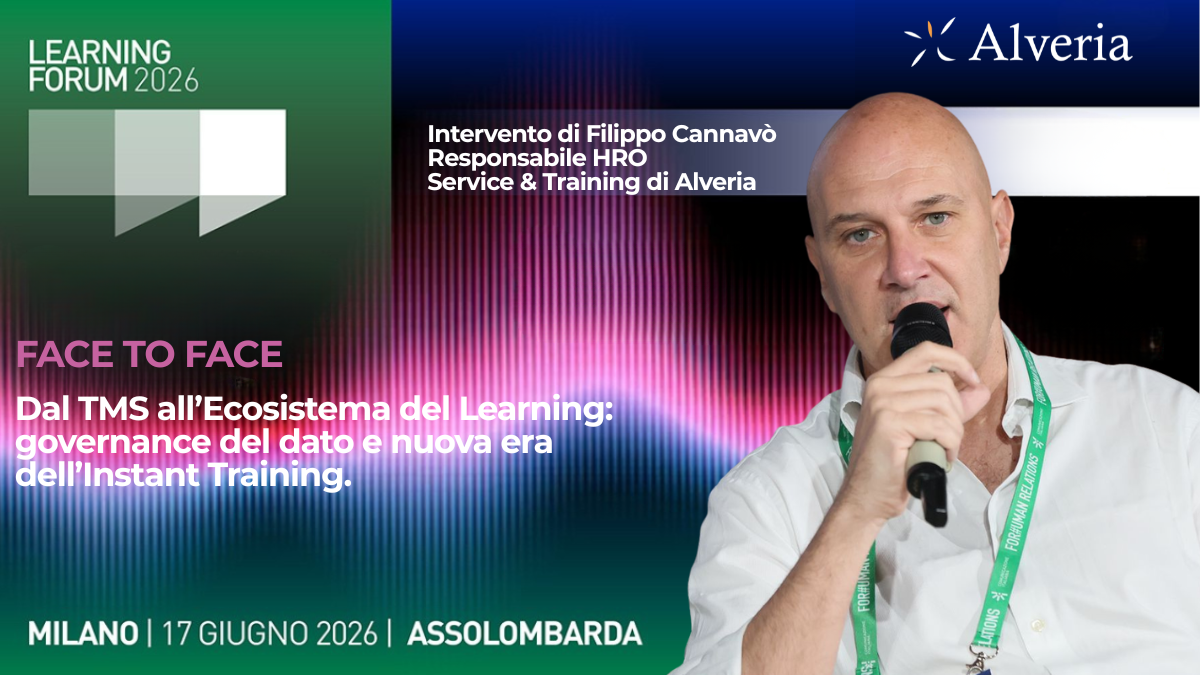
From TMS to the learning ecosystem: Filippo Cannavò discusses data governance and Instant Training
The context of the Learning Forum of Italian Communication, one of the events the most significant in Italy dedicated to wellbeing and learning for individuals, businesses and organisations, This year, the debate has centred on the future of the training and organisational development. Now in its fifth edition, the Forum reaffirms its status as a unique forum for discussion and development, where the country’s political, economic, scientific and social communities come together to explore new directions in work and skills.
It was against this backdrop that the interview entitled “From TMS to the learning ecosystem: data governance and the new era of Instant Training”, which starred Filippo Cannavò for Alveria, in conversation with Federico Luperi, News Intelligence Director of Volocom.
The discussion directly addressed the changes currently taking place in corporate training models, with a particular focus on the transition from traditional TMSs to more advanced, integrated and data-driven learning ecosystems, in which data, artificial intelligence and training processes converge within a single, valuable infrastructure.
From TMS to the learning ecosystem: the real paradigm shift
The core of the Alveria project concerns a change of perspective It is now clear that training is no longer just about managing content or platforms, but building an integrated ecosystem able to link data, processes and skills.
The transformation is structured around three key areas:
- digitisation end-to-end training processes
- integrated governance data and information HR
- a direct link between learning and objectives business
Many organisations, However, they are still in a intermediate stage, characterised by fragmented data and manual processes, with a growing gap between the potential of artificial intelligence and its actual operational application.
The value of data lies not in its quantity, but in how it is organised
A key point that emerged from the interview is that the problem is not the availability of data, but its fragmentation and lack of integration. HR information is often scattered across different systems: Excel spreadsheets, training platforms, document repositories and tools that do not communicate with one another. The result is a wealth of information that is, however, of little practical use.
The vision put forward is that of a unique ecosystem capable of centralising and harmonising data, transforming them into a structured basis for decision-making. Only in this way is it possible to cross-reference different aspects — training, performance, contractual and organisational data — and generate genuinely useful insights.
Instant Training: learning at the point of need
Another key element of the initiative is the concept of Instant Training, understood as a model of immediate, contextual learning that is integrated into workflows.
The aim is to make the business knowledge available exactly when it is needed, transforming learning into a genuine driver of performance. The starting point is a common problem: the know-how already exists, but it is fragmented. Webinars, documents, procedures and training materials are often scattered across emails and unstructured archives.
Instant Training aims to capitalise on this heritage and make it accessible in a smart, guided way.
The risk of too much content: “Netflix syndrome”
A key issue that emerged during the discussion concerns information overload. Too much content without a clear structure risks causing confusion amongst users, in a similar way to the so-called “Netflix syndrome”: There is a vast amount of content available, but it can be difficult to find what you actually need. The solution is not to reduce the amount of content on offer, but to organise it using consistent criteria that can guide users towards relevant content.
These keys include:
- professional role
- seniority level
- organisational unit
- geographical location
- business function
- operational or risk context
AI as a knowledge infrastructure
In the model described, artificial intelligence It is not merely a content-generation tool, but a genuine infrastructure for accessing knowledge. Semantic technologies and automatic classification systems make it possible to analyse large volumes of educational content and organise it in a structured way. However, without an integrated database, this potential remains untapped. The value becomes apparent when AI and structured data are combined: the same content can be tailored to different user profiles, offering personalised and context-sensitive learning pathways.
Solutions such as the Virtual Instant Training Assistant (V.I.T.A.), designed to enable smart access to corporate knowledge.
From data to performance: the value of time-to-insight
This approach has two outcomes: greater operational efficiency and a reduction in organisational debt, with a significant acceleration in time-to-insight.
Training thus becomes an integral part of business processes and a direct driver of performance, overcoming the traditional divide between learning and day-to-day operations.
The conversation between Filippo Cannavò and Federico Luperi provided a clear picture: The future of learning depends not only on technology, but on the ability to build truly integrated data ecosystems. The transition from TMS to the learning ecosystem therefore represents not only a technological evolution, but a profound cultural and organisational change, in which data, AI and training converge to form a single driver of value for organisations.
CONSULTANCY, TRAINING, HR DIGITALIZATION AND CORPORATE SOLUTIONS, DISCOVER THE ALVERIA METHOD. GET READY FOR CHANGE.
The context of the Learning Forum of Italian Communication, one of the events the most significant in Italy dedicated to wellbeing and learning for individuals, businesses and organisations, This year, the debate has centred on the future of the training and organisational development. Now in its fifth edition, the Forum reaffirms its status as a unique forum for discussion and development, where the country’s political, economic, scientific and social communities come together to explore new directions in work and skills.
It was against this backdrop that the interview entitled “From TMS to the learning ecosystem: data governance and the new era of Instant Training”, which starred Filippo Cannavò for Alveria, in conversation with Federico Luperi, News Intelligence Director of Volocom.
The discussion directly addressed the changes currently taking place in corporate training models, with a particular focus on the transition from traditional TMSs to more advanced, integrated and data-driven learning ecosystems, in which data, artificial intelligence and training processes converge within a single, valuable infrastructure.
From TMS to the learning ecosystem: the real paradigm shift
The core of the Alveria project concerns a change of perspective It is now clear that training is no longer just about managing content or platforms, but building an integrated ecosystem able to link data, processes and skills.
The transformation is structured around three key areas:
- digitisation end-to-end training processes
- integrated governance data and information HR
- a direct link between learning and objectives business
Many organisations, However, they are still in a intermediate stage, characterised by fragmented data and manual processes, with a growing gap between the potential of artificial intelligence and its actual operational application.
The value of data lies not in its quantity, but in how it is organised
A key point that emerged from the interview is that the problem is not the availability of data, but its fragmentation and lack of integration. HR information is often scattered across different systems: Excel spreadsheets, training platforms, document repositories and tools that do not communicate with one another. The result is a wealth of information that is, however, of little practical use.
The vision put forward is that of a unique ecosystem capable of centralising and harmonising data, transforming them into a structured basis for decision-making. Only in this way is it possible to cross-reference different aspects — training, performance, contractual and organisational data — and generate genuinely useful insights.
Instant Training: learning at the point of need
Another key element of the initiative is the concept of Instant Training, understood as a model of immediate, contextual learning that is integrated into workflows.
The aim is to make the business knowledge available exactly when it is needed, transforming learning into a genuine driver of performance. The starting point is a common problem: the know-how already exists, but it is fragmented. Webinars, documents, procedures and training materials are often scattered across emails and unstructured archives.
Instant Training aims to capitalise on this heritage and make it accessible in a smart, guided way.
The risk of too much content: “Netflix syndrome”
A key issue that emerged during the discussion concerns information overload. Too much content without a clear structure risks causing confusion amongst users, in a similar way to the so-called “Netflix syndrome”: There is a vast amount of content available, but it can be difficult to find what you actually need. The solution is not to reduce the amount of content on offer, but to organise it using consistent criteria that can guide users towards relevant content.
These keys include:
- professional role
- seniority level
- organisational unit
- geographical location
- business function
- operational or risk context
AI as a knowledge infrastructure
In the model described, artificial intelligence It is not merely a content-generation tool, but a genuine infrastructure for accessing knowledge. Semantic technologies and automatic classification systems make it possible to analyse large volumes of educational content and organise it in a structured way. However, without an integrated database, this potential remains untapped. The value becomes apparent when AI and structured data are combined: the same content can be tailored to different user profiles, offering personalised and context-sensitive learning pathways.
Solutions such as the Virtual Instant Training Assistant (V.I.T.A.), designed to enable smart access to corporate knowledge.
From data to performance: the value of time-to-insight
This approach yields two benefits: greater operational efficiency and a reduction in organisational debt, whilst significantly speeding up the time to insight.
Training thus becomes an integral part of business processes and a direct driver of performance, overcoming the traditional divide between learning and day-to-day operations.
The discussion between Filippo Cannavò and Federico Luperi provided a clear insight: the future of learning depends not only on technology, but on the ability to build truly integrated data ecosystems. The transition from TMS to the learning ecosystem therefore represents not only a technological evolution, but a profound cultural and organisational shift, in which data, AI and training converge to form a single driver of value for organisations.