



Beyond compliance: Quiris Holding's path to transform EU Directive 970/23 into innovation HR with Alveria
May 27, 2026
Organisational Development in the Age of AI | Report
June 4, 2026
May 28, 2026
Behind the AI label: how to recognise (and choose) the real HR revolution
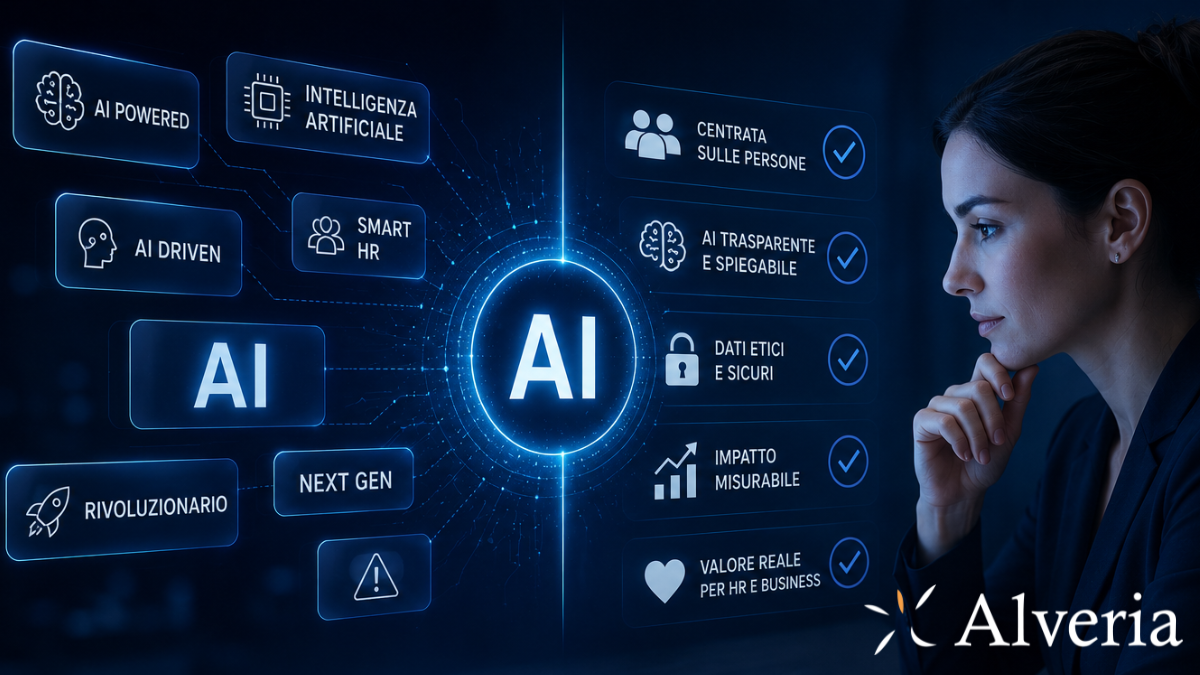
Many HR solutions today call themselves ‘AI-driven’. Few, however, really are in the way that counts. In HR, the promise is ambitious: more efficient processes, smarter decisions, increasingly personalised employee experiences. However, between declarations of intent and operational reality, a significant gap exists. Not everything that is labelled as “AI-driven”represents a real transformation. In many cases, it is a simple technological rebranding.
Behind this label, increasingly popular in human resources management software, hides an extremely heterogeneous landscape: from simple rebranded automations to platforms that truly integrate artificial intelligence models capable of learning, predicting and supporting strategic decisions.
The result is a market where real innovation and marketing coexist, making it increasingly difficult for HRs to distinguish what really improves processes from what merely renames them. But how to distinguish genuine innovation from mere technological rebranding?
The phenomenon of ’AI washing“ in HR
Similar to “greenwashing” in the world of sustainability, the’AI washing” describes the tendency of companies and suppliers to label existing solutions as AI-based, without any real substantive change. In the HR context, this translates into software that automates existing processes or uses deterministic logic, but presented as intelligent systems. The risk is twofoldorganisations invest in instruments that do not generate value strategic; on the other hand, the scepticism towards AI, increasingly perceived as a fashion rather than a lever for concrete transformation.
Signs of true AI-driven HR transformation
To recognise genuine evolution is necessary go beyond labels and focus on real impacts.
Some key indicators include:
- Data-driven decisions, not simple automation
True AI does not just speed up processes, but improves the quality of decisions. Systems that analyse complex patterns in HR data to predict turnover or identify skills gaps represent a qualitative leap from traditional digitisation. - Continuous learning
Truly AI-based solutions evolve over time. They use models that learn from data, progressively improving performance instead of following predefined static rules. - Impact on employee experience
Effective AI is not invisible: it transforms people's experience. From the personalisation of career paths to real-time feedback systems, the focus shifts from administrative management to talent development. - Strategic integration, not isolated tools
The transformation does not happen through disconnected tools, but through an integrated ecosystem in which AI becomes part of the overall HR strategy.
The signs of simple technological rebranding
On the contrary, there are some recurring elements that indicate when one is faced with a more cosmetic operation than to a real AI-driven transformation. Recognising them is crucial to avoid confusing substantial innovation and simple evolution of existing tools.
- Generic and unverifiable use of the term “AI”
In many cases, the label “AI” is used in a broad and non-specific way, without clarifying which component of the system is actually based on artificial intelligence models. These are often deterministic algorithms, preset rules or simple advanced automation, presented, however, as intelligent systems. The lack of transparency about how they actually work is one of the first signs to look out for. - Lack of measurable evidence and impact metrics
A true AI-driven solution should demonstrate its value through hard data: reduced turnover, improved quality of recruitment, optimised management time or increased engagement. When these metrics are missing, or are replaced by generic descriptions of “improved efficiency”, the impact is likely to be limited or not attributable to AI in the strict sense. - Automation disguised as intelligence
Many tools merely digitise or automate existing repetitive tasks - such as managing CVs, scheduling interviews or sending standardised communications - without introducing predictive or decision-making capabilities. In these cases, technology improves operating speed, but does not change the quality of HR decisions. - Absence of impact on decision-making and organisational processes
One of the most relevant criteria concerns the level of influence on decision-making. If thetechnology is limited to supporting executive activities without affecting the selection, development or strategic planning of resources, one cannot speak of true transformation. Instead, genuine AI enters decision-making processes, helping to guide them through insights, predictions and recommendations.
In these scenarios, the value generated is predominantly operational: efficiency and standardisation are gained, but there is no structural change in the HR model. The distinction between incremental improvement and real transformation thus becomes the key point for assessing the maturity of the solutions adopted.
The critical role of leadership HR
Distinguishing between hype and value requires new skills. HR leaders need to develop digital literacy and critical skills in analysing solutions.
It is not about becoming a technical expert, but about knowing how to ask the right questions:
- What problem does this solution really solve?
- How do you use the data?
- Is it able to learn and improve over time?
- What measurable results has it already produced?
This is the only way to avoid ineffective investments and drive genuine transformation.
From technology to culture
The difference between true transformation and mere technological rebranding lies not in the technology itself, but in the way it is adopted, integrated and made part of decision-making processes. AI can truly revolutionise the HR, but only if it is implemented with awareness, rigour and a clear strategic direction. In an increasingly promising environment, the ability to distinguish between substance and appearance becomes a key competence: the future of the HR will not be defined by those who talk about AI, but by those who actually know how to use it.
Contact us to discover how a truly AI-driven HR platform can support more informed, effective and strategic decisions.
CONSULTANCY, TRAINING, HR DIGITALIZATION AND CORPORATE SOLUTIONS, DISCOVER THE ALVERIA METHOD. GET READY FOR CHANGE.
Many HR solutions today call themselves ‘AI-driven’. Few, however, really are in the way that counts. In HR, the promise is ambitious: more efficient processes, smarter decisions, increasingly personalised employee experiences. However, between declarations of intent and operational reality, a significant gap exists. Not everything that is labelled as “AI-driven”represents a real transformation. In many cases, it is a simple technological rebranding.
Behind this label, increasingly popular in human resources management software, hides an extremely heterogeneous landscape: from simple rebranded automations to platforms that truly integrate artificial intelligence models capable of learning, predicting and supporting strategic decisions.
The result is a market where real innovation and marketing coexist, making it increasingly difficult for HRs to distinguish what really improves processes from what merely renames them. But how to distinguish genuine innovation from mere technological rebranding?
The phenomenon of ’AI washing“ in HR
Similar to “greenwashing” in the world of sustainability, the’AI washing” describes the tendency of companies and suppliers to label existing solutions as AI-based, without any real substantive change. In the HR context, this translates into software that automates existing processes or uses deterministic logic, but presented as intelligent systems. The risk is twofoldorganisations invest in instruments that do not generate value strategic; on the other hand, the scepticism towards AI, increasingly perceived as a fashion rather than a lever for concrete transformation.
Signs of true AI-driven HR transformation
To recognise genuine evolution is necessary go beyond labels and focus on real impacts.
Some key indicators include:
- Data-driven decisions, not simple automation
True AI does not just speed up processes, but improves the quality of decisions. Systems that analyse complex patterns in HR data to predict turnover or identify skills gaps represent a qualitative leap from traditional digitisation. - Continuous learning
Truly AI-based solutions evolve over time. They use models that learn from data, progressively improving performance instead of following predefined static rules. - Impact on employee experience
Effective AI is not invisible: it transforms people's experience. From the personalisation of career paths to real-time feedback systems, the focus shifts from administrative management to talent development. - Strategic integration, not isolated tools
The transformation does not happen through disconnected tools, but through an integrated ecosystem in which AI becomes part of the overall HR strategy.
The signs of simple technological rebranding
On the contrary, there are some recurring elements that indicate when one is faced with a more cosmetic operation than to a real AI-driven transformation. Recognising them is crucial to avoid confusing substantial innovation and simple evolution of existing tools.
- Generic and unverifiable use of the term “AI”
In many cases, the label “AI” is used in a broad and non-specific way, without clarifying which component of the system is actually based on artificial intelligence models. These are often deterministic algorithms, preset rules or simple advanced automation, presented, however, as intelligent systems. The lack of transparency about how they actually work is one of the first signs to look out for. - Lack of measurable evidence and impact metrics
A true AI-driven solution should demonstrate its value through hard data: reduced turnover, improved quality of recruitment, optimised management time or increased engagement. When these metrics are missing, or are replaced by generic descriptions of “improved efficiency”, the impact is likely to be limited or not attributable to AI in the strict sense. - Automation disguised as intelligence
Many tools merely digitise or automate existing repetitive tasks - such as managing CVs, scheduling interviews or sending standardised communications - without introducing predictive or decision-making capabilities. In these cases, technology improves operating speed, but does not change the quality of HR decisions. - Absence of impact on decision-making and organisational processes
One of the most relevant criteria concerns the level of influence on decision-making. If thetechnology is limited to supporting executive activities without affecting the selection, development or strategic planning of resources, one cannot speak of true transformation. Instead, genuine AI enters decision-making processes, helping to guide them through insights, predictions and recommendations.
In these scenarios, the value generated is predominantly operational: efficiency and standardisation are gained, but there is no structural change in the HR model. The distinction between incremental improvement and real transformation thus becomes the key point for assessing the maturity of the solutions adopted.
The critical role of leadership HR
Distinguishing between hype and value requires new skills. HR leaders need to develop digital literacy and critical skills in analysing solutions.
It is not about becoming a technical expert, but about knowing how to ask the right questions:
- What problem does this solution really solve?
- How do you use the data?
- Is it able to learn and improve over time?
- What measurable results has it already produced?
This is the only way to avoid ineffective investments and drive genuine transformation.
From technology to culture
The difference between true transformation and mere technological rebranding lies not in the technology itself, but in the way it is adopted, integrated and made part of decision-making processes. AI can truly revolutionise the HR, but only if it is implemented with awareness, rigour and a clear strategic direction. In an increasingly promising environment, the ability to distinguish between substance and appearance becomes a key competence: the future of the HR will not be defined by those who talk about AI, but by those who actually know how to use it.
Contact us to discover how a truly AI-driven HR platform can support more informed, effective and strategic decisions.