



Pay Transparency Form
Pay Transparency Software: how it supports the analysis and management of the gender pay gap
Good pay transparency software does more than simply calculate an indicator. It transforms pay data into analyses that the company can explain, verify and document.
Legislative Decree 96/2026 has been in force since 7 June 2026. Companies with at least 100 employees must report their gender pay gap, with deadlines staggered according to company size: the first reports are due from 7 June 2027. The figure alone is not enough. It is necessary to understand how roles are assessed, which roles are of equal value, where the gap originates and what the cost of taking action would be.
The Alveria Pay Transparency module enables these variables to be managed within a single environment: from job evaluation to decision-making governance.
The four-step process
Why pay transparency requires data and a method
The legislation requires a comparison to be made between people who carry out the same work or work of equal value. The comparison must be based on three factors.
The first is the key criterion. Directive (EU) 2023/970 sets out skills, commitment, responsibilities and working conditions, to be applied in an objective and gender-neutral manner. The second is comprehensive, historical pay data based on mandatory calculation metrics (the seven indicators) which analyse: fixed pay, variable pay and ancillary components. The third is the use of a repeatable method, which can be reviewed months later and presented to employee representatives in order to be considered robust and reliable
Comprehensive pay transparency software manages these three elements synergistically, from job evaluation to the documentation of the methodology. A spreadsheet can produce a metric. However, when data comes from multiple sources and every decision must be documented, it becomes difficult to maintain consistency, version control and traceability: this is where specialist pay transparency software makes the process repeatable.
What do Legislative Decree 96/2026 and Directive (EU) 2023/970 provide for?
Legislative Decree No. 96 of 7 May 2026, published in the Official Gazette No. 125 of 1 June 2026, transposes Directive (EU) 2023/970. The rules on job advertisements, pay criteria and the right to information apply to both public and private sector employers. Reporting on the pay gap applies to organisations with at least 100 employees.
In practice, the company must monitor four areas: the criteria it uses to assess roles; comprehensive and up-to-date pay data; the communication of results and information required to be provided to employees and the monitoring body; and the rectification of unjustified pay differences. The table below links each requirement to the support provided by software compliant with EU Directive 2023/970, such as that offered by Alveria.
7 June 2026
Entry into force of Legislative Decree 96/2026. Notices, remuneration criteria and the right to information.7 June 2027
Initial reporting for companies with at least 250 employees (and annually thereafter) and for those with 150–249 employees (and every three years thereafter).7 June 2031
Initial reporting for companies with 100–149 employees, followed by reporting every three years.
| REQUIREMENT | SCOPE AND DEADLINES | WHAT THE COMPANY NEEDS TO MANAGE | HOW ALVERIA PROVIDES SUPPORT |
|---|---|---|---|
| Equal-value criteria (Legislative Decree No. 96/26, Article 4) | All employers | Assess roles using objective, gender-neutral criteria: skills, commitment, responsibility and working conditions | Assessment based on three pillars plus working conditions; K-Means for categories of equal value |
| Job advertisements and remuneration criteria | All employers, from 7 June 2026 | Inform candidates of the starting salary or pay band; do not ask about their previous salary history; make the criteria for pay and progression transparent | Position-based pay policy (JEP) as an objective benchmark for pay bands and criteria |
| Right to information (Article 7) | All employers in relation to all categories of workers | Provide information on individual pay levels and average pay levels by gender, by categories of equal value | Individual comparison; Pay gap by cluster |
| Reporting on the gap (Article 9) | Employers with at least 100 employees.
|
Collect and report to the monitoring body: average and median pay gaps (overall and for variable components), the proportion of workers with variable components, quartiles, and pay gaps by category | Pay gap with indicators based on Article 9, breakdown by fixed and variable pay and quartiles; export for the monitoring body |
| 5% threshold and joint assessment (Article 10) | Entities subject to reporting requirements. An average pay gap of ≥5% within a category of workers, not justified by objective and neutral criteria and not rectified within six months of notification | Justify the difference or rectify it; failing that, carry out a joint assessment with the workers’ representatives | Alerts for clusters ≥5%; Oaxaca-Blinder; simulation of interventions; Audit Trail |
In response to Legislative Decree 96/2026, Alveria Pay Transparency has been developed in full compliance with the decree. The software supports analysis, reporting, traceability and the management of regulatory obligations, but it does not, on its own, guarantee corporate compliance. Methodological choices and decisions remain the responsibility of the company.
Official sources: Official Journal (OJ No. 125 of 1 June 2026); EUR-Lex (EU Directive 2023/970).
Job evaluation: from job grading to categories of equal value
A comparison between men and women only makes sense when they are on an equal footing. When the comparison is limited to job classification, it remains to be seen whether skills of a different nature (technical and specialist, interpersonal, organisational and care-related) are assessed by the same standards.
Weighting positions using a gender-neutral engine
The Alveria job evaluation software assesses each role across three pillars – Skills, Responsibilities and Effort – plus Working Conditions, in line with the four criteria of the Directive. Each pillar has configurable sub-factors and scales. The scores, normalised from 0 to 100, are combined to form the JE Score. The profile follows a workflow: draft, validated, approved.
Weights, scales and grids are configured using HR, in a no-code environment, and each parameter is versioned. The job evaluation engine is native and does not require an external survey. The scales are overwritable: the same engine can support different weighting models and complement the professional classification system already in use. The cost of weighting roles depends on the scope: how many roles are being assessed and using which model.
Assign scores to clusters of equal value
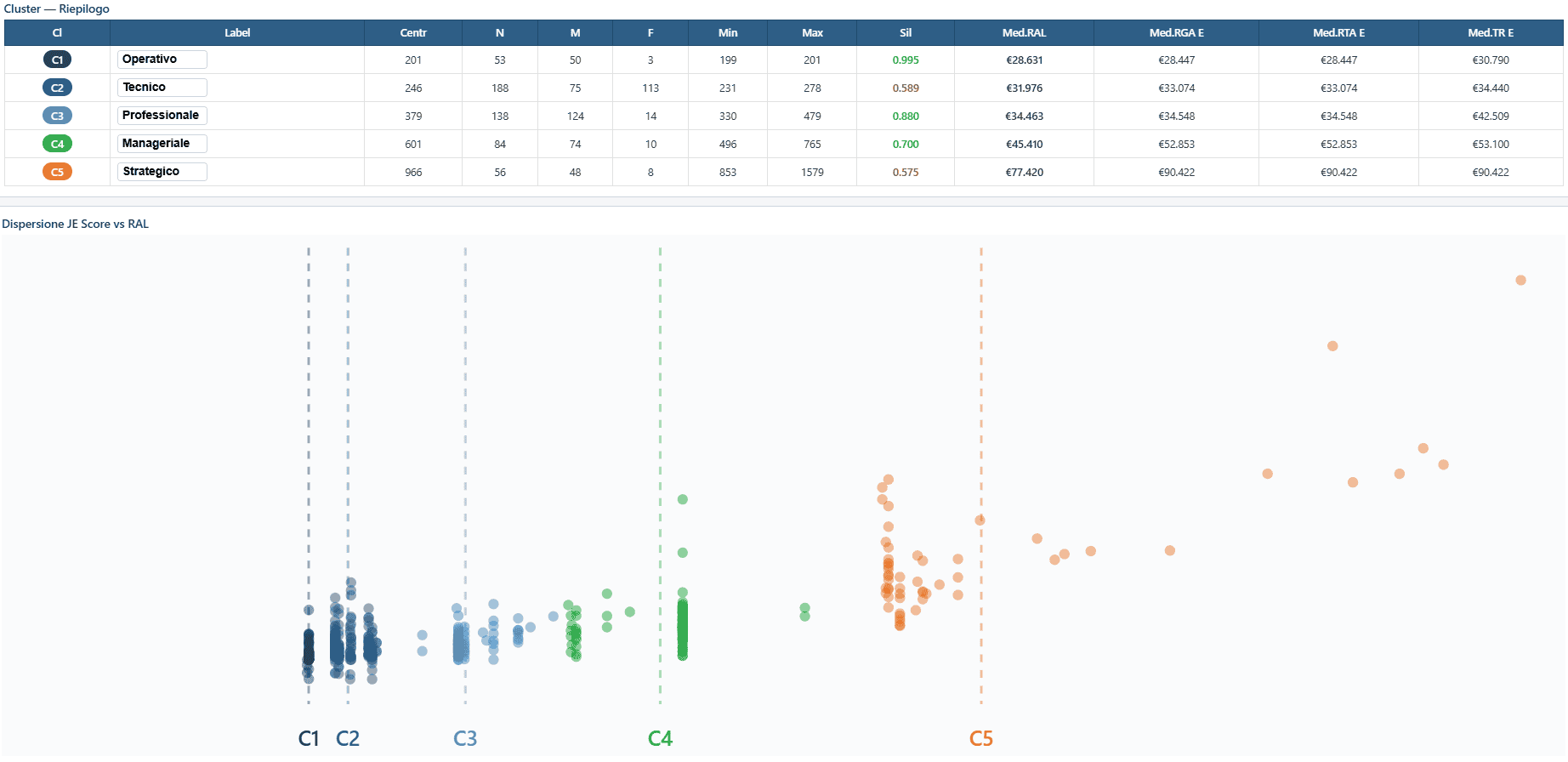
Using the K-Means algorithm, Alveria Pay Transparency groups roles with similar JE Scores into clusters: these are the categories of equal value upon which the comparison is based. The number of clusters is selected during the analysis phase and their quality is measured using the Silhouette index, which also highlights borderline roles. Each scenario is saved and, if the assessments change, the system indicates that the analysis should be repeated. The simulation mode allows scenarios to be tested before they are finalised.

Measuring the Gender Pay Gap: metrics, categories and warning signs
Alveria Pay Transparency calculates the pay gap in several ways, because a single indicator tells us very little:
- Overall and median gender pay gap;
- difference between players in the same position;
- the segregation effect, which isolates the part of the gap that is attributable to the distribution of men and women across roles.
The analyses are available by cluster and by level or category, showing the breakdown between basic and variable pay and the distribution by quartile. Automatic alerts flag clusters with a gap of 5% or greater, and the views within the tool reflect the indicators set out in Article 9 of Legislative Decree 96/2026.
A standalone gender pay gap calculator only provides a partial answer. A useful company-wide gender pay gap analysis, such as Alveria Pay Transparency, starts with assessed roles and defined clusters, and provides dedicated dashboards for the pay gap and the gender pay gap.
OBSERVATORY 970
Pay Transparency:
Is your company ready?
Find out in just a few minutes.
Complete the questionnaire and compare your company with the others in the panel: Are you ahead or do you need to catch up?
Take part
at the 970 observatory
Online
Measuring the pay gap merely tells us how large it is. Pay equity analysis, on the other hand, seeks to understand where the gap originates. Pay equity software combines aggregate data with the Oaxaca-Blinder decomposition. It breaks down the pay gap into an explained component and an unexplained component:
- The first is attributable to the deviation from the observable variables chosen by the company. The model uses the logarithm of hourly pay, with configurable explanatory variables, and provides robustness indicators for the sample alongside operational recommendations.
- The unexplained portion, on the other hand, highlights the part of the gap that the model cannot attribute to the variables considered and which may therefore require further investigation. It is not evidence of discrimination and does not identify causes: it depends on the variables chosen and the quality of the data. It serves to segment the phenomenon, to guide HR audits and to enable the selection of targeted interventions.
A properly conducted pay equity audit starts here: measuring, breaking down, identifying areas for further investigation, and documenting. This is how pay transparency and pay equity software moves from mere figures to providing explanations and supports the analysis of pay gaps.
Explaining the pay gap: Pay equity and component analysis
Individual analysis and requests for information
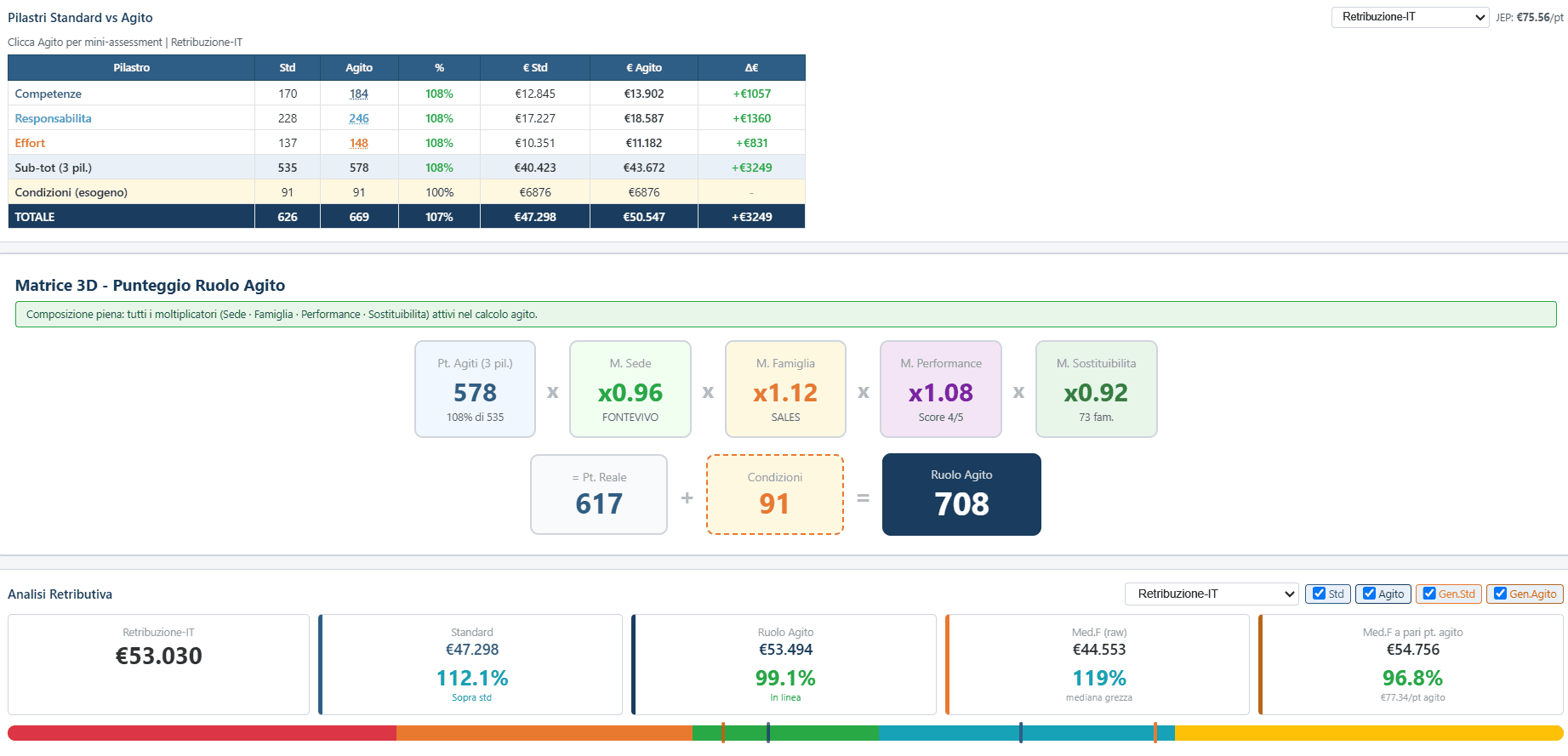
The aggregate pay gap does not address the situation of any one individual. Alveria Pay Transparency, with its Comparatio feature, compares the employee against the standard for their role: for each individual, the module displays the standard, recommended and actual pay, along with the percentage gap. Comparatio breaks down the gap into its constituent factors (Location, Family, Performance, Replaceability): in this way, the figure becomes understandable.
It is at the heart of a software programme for individual pay analysis. It helps HR to identify differences between comparable employees, to formulate pay-related communications and to prepare responses to employees' requests for information (Legislative Decree 96/26, Article 7). Remuneration mapping by position and by cluster completes the picture of the remuneration analysis.

From the gender pay gap to the budget: simulating the cost of adjustments
When a pay gap emerges, the question changes: how much does it cost to rectify it? Alveria Pay Transparency manages the process in four steps.
Diagnosis
The pay gap by cluster and alerts from 5% indicate where action is needed. The unexplained portion guides the in-depth analysis.
Speech
Comparatio compares actual and recommended remuneration on an individual-by-individual basis. The JEP defines the standard remuneration for the role.
Cost
The JEP enables the weightings to be broken down and the impact on pay to be simulated. The differences between actual and recommended pay, aggregated by cluster, provide a basis for estimating the cost of measures to address the gender pay gap.
Budget
Scenarios inform the decision. The budget remains a choice made by the company, not an automatic outcome.
How much does it cost to comply with the Pay Transparency Directive? The cost of compliance comprises two components: changes to remuneration and process costs, namely software, data analysis and services. Pay adjustment simulation software addresses the first component by estimating the expected impact of a change; the second depends on the scope and the services selected. The simulation of the Gender Pay Gap and pay adjustments provided by Alveria Pay Transparency allows you to compare different scenarios before committing resources.
The 5% mechanism provides a clear timeframe. If, within a category, the average pay gap is equal to or greater than 5% and is not justified by objective criteria, the company has six months from the date of notification to rectify the situation; failing this, a joint assessment with employee representatives is triggered. Estimating the cost of wage adjustments in advance helps in preparing for that decision and the compliance budget for pay transparency. When it comes to aligning with the Directive, these scenarios provide a solid basis on which to make decisions.
From assessment to structure: redesigning remuneration policies
Job evaluation is not merely an input for the analysis. It forms the basis for reviewing the remuneration structure.
The JEP (Job Evaluation Point) in Alveria Pay Transparency assigns a value in euros to each evaluation point, starting from the median of the cluster, and translates this into a standard position-based remuneration and a remuneration policy by position and by cluster. The configured positions can be applied to the policy.
Anyone tasked with initiating the redesign of the remuneration structure, the review of pay bands, the redesign of the remuneration system or the creation of a remuneration framework from scratch will thus find a framework anchored to the value of the roles. As a tool to support the redesign of remuneration policies, Alveria’s remuneration analysis software provides this objective basis and allows for the simulation of potential impacts. The design process remains the responsibility of the company, with its own remuneration policy decisions and industrial relations.
Reporting, audit trails and governance
An analysis is valid if it can be repeated and justified. The Gender Pay Gap Report by Alveria Pay Transparency is based on the same calculation metrics: overall and median pay gaps, pay gaps in variable components, quartiles and employee categories. A data export function is provided for reporting the pay gap to the monitoring body. The same engine powers the Gender Pay Gap Reporting: the indicators set out in Article 9 of Legislative Decree 96/26 follow the calculation rules used for the analysis, and the gender pay gap report remains consistent with the source data.
The audit trail records who changed what and when. Every configuration change (scope, weights, scales, grids) is saved as a new version, which can be viewed and restored. The expiry dates and validity of parameters are monitored: valid, due to expire, expired. The methodology remains documented and verifiable, including by employees’ representatives. For a gender pay audit, this traceability is what stands the test of time.
Governance brings everything full circle: a central body that receives the analyses, decides on the actions to be taken and verifies the outcomes. It is the continuity between measurement, explanation, simulation and governance that distinguishes specialist software from a simple calculation tool: every analysis remains linked to positions, clusters and configuration versions.
Integration and configuration: what IT needs to check
For the IT Manager, a pay transparency software solution must answer one question: where is the data stored and who configures the model? The module is native to HCMS. The Employee Advanced Book (EAB) collects, standardises and archives personnel data from connected systems. The remuneration scope is based on gross annual salary (RAL), variable pay, gross annual allowance (RGA), gross annual bonus (RTA) and total remuneration (Total Rem), both theoretical and actual. Key linkages include the RAL from payslips, the superminimum, one-off company costs and benefits. Positions, job roles, organisational units and resources are entities already present on the platform.
Anyone looking for pay transparency software with payroll integration, or with the HR management system, or a HRIS integration, will find what they’re looking for at EAB. Pay slip data feeds into the analysis, whilst payroll processing remains the responsibility of the dedicated system.
Weights, scales, grids and scope are configured in HR using a no-code approach, without the need for dedicated development: this helps to reduce the cost of IT integration. With a defined scope and reliable baseline data, the system can be up and running within a few weeks.
How to evaluate pay transparency software
Eight criteria enable a comparison of pay transparency solutions without relying on generic rankings.
| CRITERION | QUESTION TO ASK | IN THE ALVERIA FORM |
|---|---|---|
| Position assessment | Is there a gender-neutral weighting engine, or is an external methodology required? | Native engine based on three pillars plus Conditions; configurable scales |
| Categories of equal value | How are clusters built and verified? | K-Means with the Silhouette index; archive of runs |
| Measuring the gap | Which metrics, and at what level of detail? | Overall GPG, median, on an equal basis, segregation effect; by cluster and level; base/variable; quartiles |
| Explanation | Is the gap broken down or simply aggregated? | Oaxaca-Blinder: the explained and unexplained share |
| Individual analysis | Is the person being assessed against the role standard? | Comparatio with a performed role |
| Simulation | Do you assess the impact before making a decision? | JEP with impact simulation; simulation mode in clusters |
| Traceability | Is the methodology version-controlled and can it be restored? | Audit Trail |
| Integration and configuration | Where does the data come from, and who sets it up? | EAB; no-code configuration managed by HR |
To apply these criteria to your situation, you can discuss the features and selection criteria with a Alveria expert.